
When a patient first asks me about dental implants, the questions to ask before dental implants often start with price. I understand why. It is a real cost, and it usually arrives at a moment when a tooth has already caused enough trouble. But price is not the first clinical question I want to settle. The better question is: what has to be true for this implant to be right for me long-term?
Those are the questions to ask before dental implants because an implant is not a product taken from a shelf. It is a decision made inside a living mouth, with bone, gum, bite, habits, medical history and time all involved. As an implant dentist, I am looking for the conditions that make treatment sensible, and for the signs that say we should pause, rebuild, clean, stabilise or choose another route.
The Question To Ask Before Dental Implants
When someone asks me whether they are suitable for dental implants, I usually want to move the question one step further. The first question is not simply whether an implant can be placed. In modern dentistry, many things are technically possible. The more useful question is: what must be true for this implant to be the right decision years from now?
I look at the mouth as a working system, not an empty space waiting to be filled. The gums need to be calm enough to support treatment. The bone needs enough volume, or a clear plan if it does not. The bite matters, because heavy or uneven forces can make a neat surgical result vulnerable in daily use.
I also need to understand medical history, medicines, diabetes control, previous gum disease, smoking, grinding, and how someone maintains their teeth when no one is watching. These details are not obstacles for the sake of it. They tell me whether the foundations match the ambition.
This is why questions to ask a dental implant dentist should include the slower, less glossy ones. What are the risks in my case? What would make you advise against treatment for now? Do I need gum treatment, bone grafting, bite changes, or time to stop smoking first? How will this be maintained after the crown is fitted?
In London, where people often move quickly between work, family, travel and appointments, suitability is not only a scan measurement. It is also whether the plan fits the person who has to live with it. At Maida Smiles and Paddington Smiles, I would rather slow treatment down than pretend a rushed plan has become sound because the diary is busy.
That is why I prefer the question what to ask before getting dental implants to include one uncomfortable line: what might make this treatment unwise for me? The answer may be active disease, too little supporting tissue, an unrealistic time frame, or a tooth that should still be saved. It may also be that an implant is appropriate, but only after the mouth has been prepared properly.
What A Proper Dental Implant Assessment Should Tell You
A dental implant assessment should slow the decision down. Before I ask anyone to consent, I want the appointment to answer a simple question: is this the right treatment, in this mouth, at this time? That begins with a clinical examination of the teeth, the space, the gums and the way the jaws meet.
The gums matter as much as the bone. Gum disease and dental implants are a poor combination if the disease is active or poorly controlled, because inflammation around natural teeth can also threaten an implant. I check pocket depths, bleeding, plaque control, recession, gum thickness and whether neighbouring teeth are stable.
Your medical and dental history should be treated as part of the assessment, not paperwork at the edge of it. Diabetes, some medicines, previous radiotherapy, osteoporosis drugs, clenching, past gum treatment, failed dental work and anxiety can all shape the plan. I also assess the bite carefully, especially if there is grinding, heavy wear or several missing teeth.

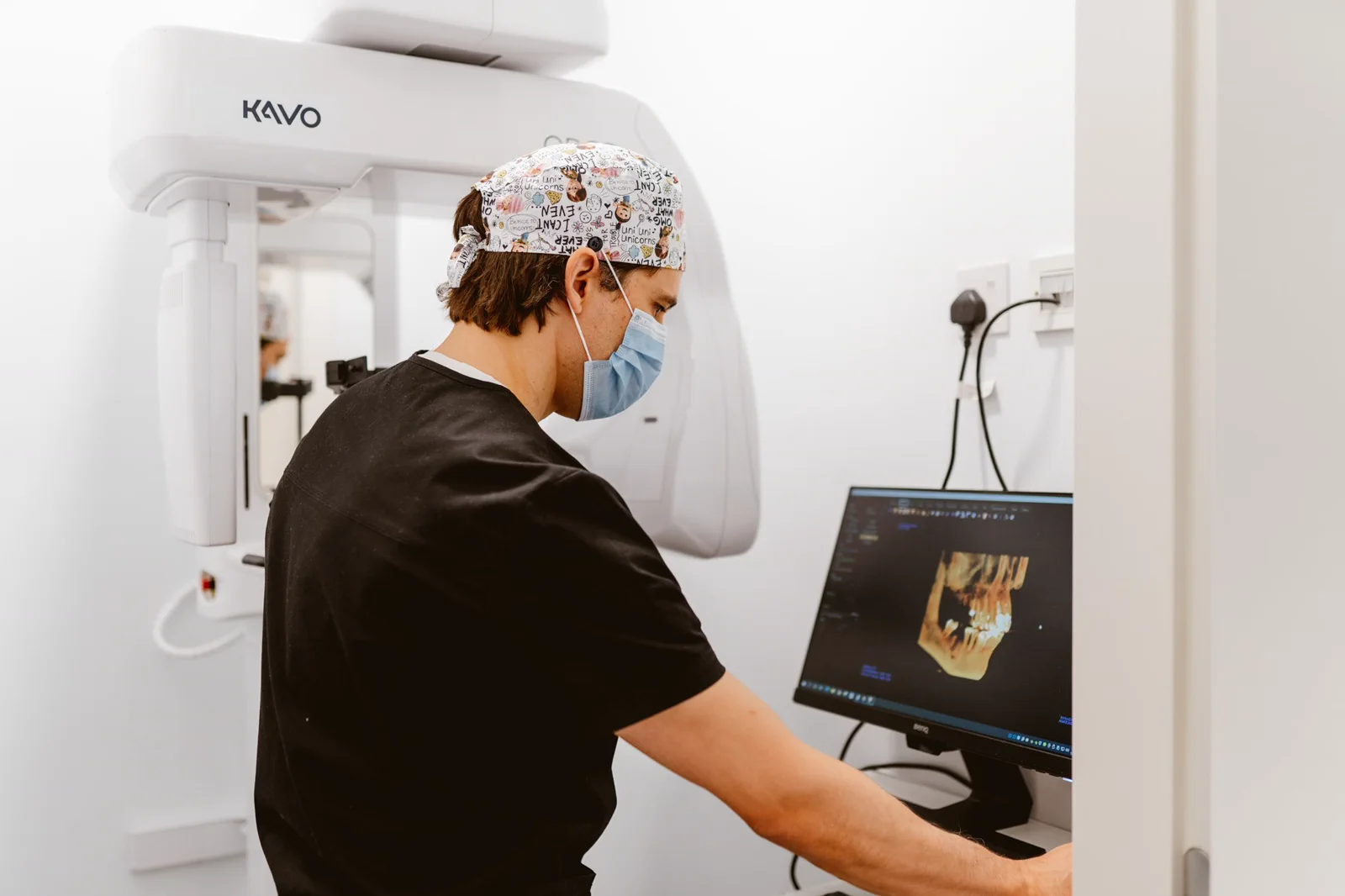
Photographs, digital scans and conventional X-rays help me record what is present and explain the options. A CBCT scan for dental implants is sometimes needed when the bone shape, sinus, nerve position or previous infection cannot be judged safely from ordinary X-rays. It is not a promise of success. It is a diagnostic tool.
A good assessment should also explain what the scan does not decide. A CBCT can show me where bone is missing, where anatomy must be respected and how an implant might be angled, but it cannot clean the gums, change a smoking habit or make a heavy bite gentle. The image informs judgement; it does not replace it.
By the end, you should know the main risks, the sequence, the likely time frame and the alternatives to dental implants, such as a bridge, denture, orthodontic space closure or leaving a space under review. Sometimes the answer is: not yet. Active gum disease, heavy smoking, uncontrolled medical risk, too little bone, untreated infection or an unstable bite may mean treatment should be delayed, changed or avoided.
Alternatives deserve the same care as the implant plan. A bridge may be sensible when neighbouring teeth already need crowns. A denture may be the kinder route for someone who wants a less surgical option. Sometimes orthodontics, root treatment, periodontal care or simple observation gives a better sequence. Patients should never feel that asking about alternatives is disloyal. It is part of informed consent.
Risks, Costs And The Promise Of Long-Term Care
When I talk through dental implant risks and benefits, I try to keep the conversation sober. An implant is a medical device placed into living bone, not a mechanical shortcut. Consent matters because the patient needs to understand what is being proposed, what the alternatives are, what may go wrong and what maintenance will be needed afterwards.
The dental implant failure risk factors I look for are often ordinary things, not dramatic ones. A history of gum disease can leave the supporting tissues more vulnerable. Smoking affects healing and increases biological risk. Diabetes is not an automatic barrier, but control matters. Bone quality, available volume, bite forces, clenching, hygiene and missed reviews all have a part to play.
A 97.6% implant success rate is encouraging in my own implant work, but I would never use that number as a promise to the person sitting in front of me. The more honest question is what changes that person's risk: the biology, the bite, the design of the restoration, their cleaning, and whether we can review problems early rather than late.
The cost of dental implants London patients are quoted can vary because the word implant may hide several stages. Good diagnostics may include scans, photographs, digital planning and periodontal assessment. Some patients need extraction, bone grafting, sinus work or soft-tissue improvement before placement. The fee may also depend on components, laboratory work, provisional teeth, the final restoration and follow-up.
This is where trust becomes practical rather than abstract. I want a patient to know who is responsible for the surgical stage, who designs and fits the final tooth, how communication works between appointments, and what we will do if healing takes longer than expected. A confident plan can still contain uncertainty. What matters is that the uncertainty is named before treatment begins.
Useful dental implant treatment plan questions include: what are my alternatives, what are my personal risks, do I need grafting, what is provisional, what is final, what is included in review visits, and how will problems be handled later? Dental implant maintenance is not an afterthought; it is part of the treatment.
Dental implant maintenance is not an afterthought; it is part of the treatment.
Dr Pedro Gutierres
So, is a dental implant the right answer? Sometimes it is, and sometimes the wiser work is to pause. A good consultation should leave a patient understanding why an implant may help, and what could make it fail or make it wrong for now: thin bone, active gum disease, smoking, grinding, medical history, cost, time or a bite that has not yet been understood.
As an implant dentist, I am not looking for the quickest route to a screw in bone. I am looking for the route that respects the mouth it will live in. I would rather a patient leaves with a slower, safer plan than a fast answer built on incomplete information. That is the point of the consultation.